(Why Developmental Thinking Changes Everything)
There’s a quiet assumption woven into much therapeutic work:
that if we stay present-focused enough, insight and change will follow.
For many clients, this is true.
But for others – often those with early relational trauma – something essential gets missed when therapy remains anchored only in the present.
These are the clients who:
- Understand their patterns, yet repeat them
- Make progress, then suddenly regress
- React intensely to moments that seem minor
- Leave therapists feeling thoughtful… but ineffective
When we work solely in the present, these experiences can feel confusing.
Attachment-informed work invites us to consider something different:
Some difficulties don’t belong to the present at all.
They belong to an earlier time – one the nervous system never left.
Development doesn’t happen evenly
Human development is not a smooth, linear process. It unfolds in the context of relationship, regulation, and safety.
When those conditions are disrupted early on, development doesn’t simply stop – it adapts.
Parts of the self grow up.
Other parts stay young.
This is why many adult clients can function competently in some areas of life while feeling utterly overwhelmed in others. Different parts of the self are operating at different developmental ages.
When therapy addresses only the adult-presenting part, younger parts remain unseen – and unchanged.
When the present feels disproportionately charged
One of the clearest signs that developmental material is present is emotional intensity that doesn’t match the current situation.
A delayed reply feels like abandonment.
A boundary feels like rejection.
A small rupture feels catastrophic.
From a present-focused lens, this can look like over-sensitivity or poor affect regulation.
From a developmental lens, it makes perfect sense.
The nervous system isn’t responding to this relationship – it’s responding to an earlier one where proximity, attunement, or safety were unreliable or absent.
Time collapses.
And therapy becomes the stage on which unfinished developmental business quietly plays out.
Why insight alone often isn’t enough
Many counsellors notice a particular kind of stuckness with clients who can articulate their history beautifully – yet remain emotionally unchanged.
They know what happened.
They understand the pattern.
They can even anticipate their reactions.
And still, the same feelings return.
This isn’t because insight has failed.
It’s because developmental experiences are stored implicitly – in the body, in the nervous system, in relational expectation – not in narrative memory.
You cannot think your way out of something that was never encoded in thought.
When therapy stays present-focused, it can inadvertently bypass the very material that needs attention.
The child in the adult story
Thinking developmentally doesn’t mean regressing clients or turning therapy into a search for childhood trauma.
It means recognising that early experiences shape how safety, closeness, and selfhood are organised.
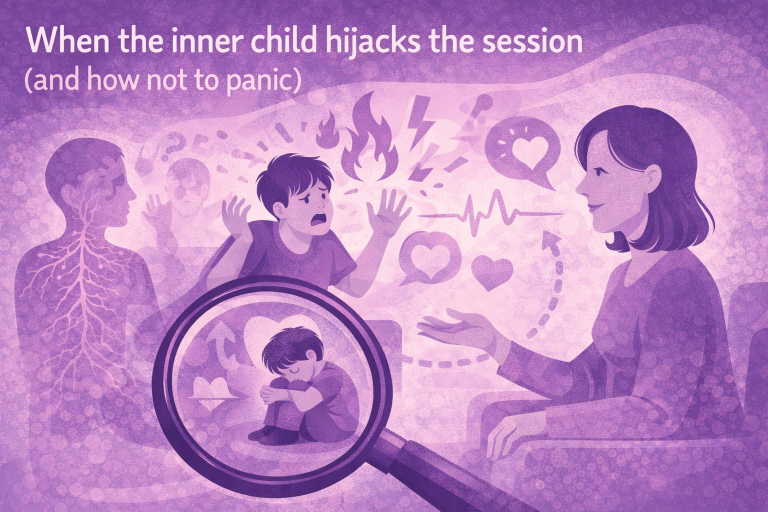
When a client reacts with fear, shame, or desperation, it’s often a younger part of the self responding – one that learned long ago how relationships worked.
These parts don’t respond well to logic, reassurance, or explanation.
They respond to:
- Slowness
- Predictability
- Emotional containment
- Relational safety over time
Which is why attachment-focused work often feels slower – and deeper – than approaches that prioritise symptom change alone.
What this asks of the therapist
Working developmentally shifts the therapist’s role.
We’re no longer just helping clients make sense of the present.
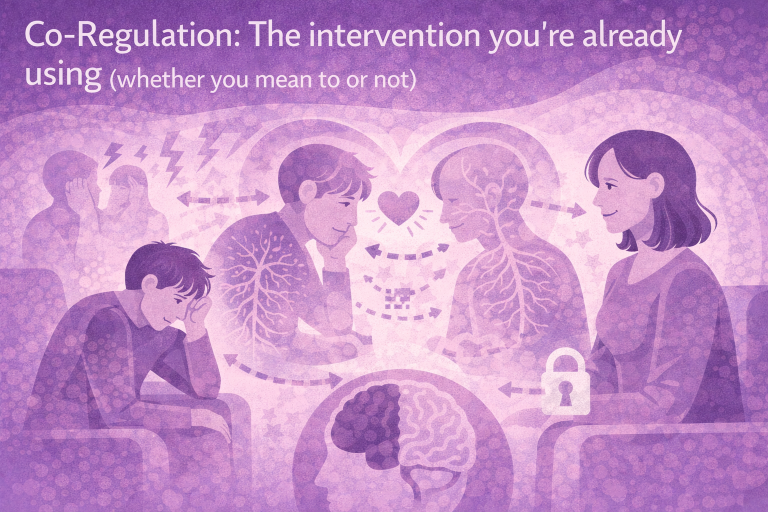
We’re helping them create new experiences in relationships.
This requires:
- Tolerating not knowing
- Staying with intensity without rushing to resolve it
- Noticing our own impulses to fix, reassure, or explain
- Holding boundaries while remaining emotionally available
It also requires humility – acknowledging that some change happens through experience, not intervention.
When therapy becomes a new developmental space
For clients with early attachment wounds, therapy can become a place where development quietly resumes.
Not dramatically.
Not quickly.
But relationally.
A client pauses instead of panicking.
Names confusion instead of collapsing.
Stays connected through discomfort.
These moments may seem small, but developmentally, they are profound.
They represent something that couldn’t happen earlier – happening now, in a relationship.
A different way of understanding repetition
When clients repeat patterns, attachment-informed work asks us not what’s wrong, but what’s unfinished.
Repetition isn’t failure.
It’s the psyche’s way of seeking completion.
When we meet repetition with curiosity rather than impatience, therapy becomes less about progress and more about integration.
And paradoxically, that’s often when movement begins.
A reflection to hold
You might reflect on this in your own work:
- Which clients seem “stuck” despite insight?
- Where might younger parts be holding the distress?
- What happens when you slow down instead of moving on?
When we allow ourselves to think developmentally, therapy often becomes less tidy – and more alive.
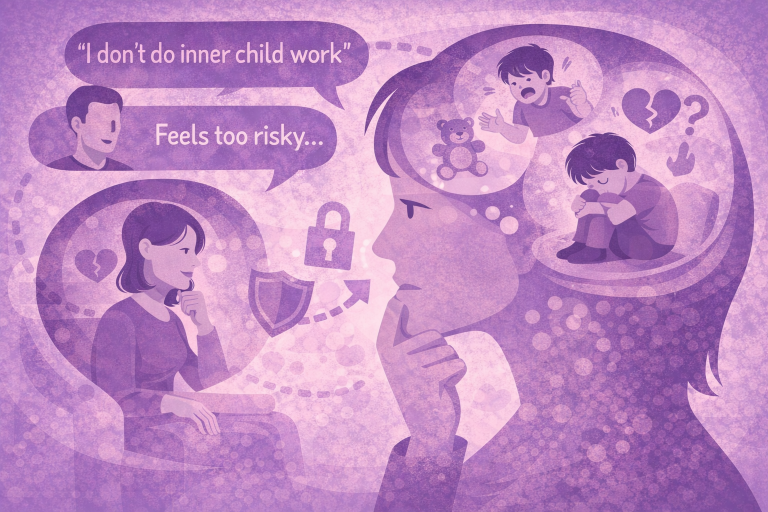
In the next blog, we’ll explore what it really means to meet the inner child in the room – and why this work is far more grounded, ethical, and necessary than it’s sometimes made out to be.
For now, you might simply notice this:
What shifts when you stop asking “Why now?” and start asking “When did this first make sense?”
Sometimes, that single question changes everything.